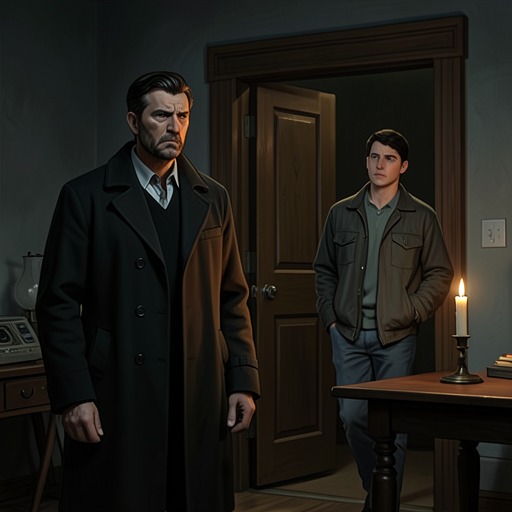
John Allan
The Pale Blue EyeJohn Allan is Edgar Allan Poe’s foster guardian, but the novel leaves the meaning of that bond sharply contested. Poe describes a childhood in which Allan took him into his household and made him an heir; Allan later denies that he adopted Poe or promised him a son’s place. Their conflict over money and obligation becomes more than a quarrel between benefactor and dependent: through Allan, the novel brings Poe’s claims about his past into collision with the voice of the man who shared it.
Identity and Background
Poe recounts that Allan took him into his home and undertook to raise him as a gentleman, in keeping with what Poe believed his dead mother would have wanted. In telling Lea Marquis about his life, Poe presents Allan as the person who had made him an heir and given him a household after he was orphaned. He also recalls Allan’s late wife as a second mother. This account establishes a relationship that, in Poe’s telling, was familial as well as financial, and makes Allan’s support—or refusal of it—central to Poe’s sense of what he was owed.
The novel does not let that version stand uncontested. When Augustus Landor calls Poe Allan’s son, Allan immediately objects. He says that he and his late wife took pity on Poe and housed him as they might shelter a stray dog or an injured bird, but that he never adopted the boy or led him to believe he would. Allan allows that Poe has claims on him as any Christian soul might, but denies a special family bond. The contradiction is consequential: Poe’s account emphasizes inheritance and parental responsibility, while Allan recasts the same history as temporary shelter and charity. The book supplies both statements without reconciling them.
Poe’s Account of Support and Denial
In conversation with Augustus Landor at Benny Havens’ tavern, Poe describes a long pattern of scrutiny and refusal. He says Allan would not clothe or educate him as a gentleman, and that expenses were repeatedly questioned or begrudged. When Poe needed help publishing his first volume of verse, Allan rejected the request on the grounds that men of genius should not seek his aid. Poe also recalls needing fifty dollars to pay for an Army replacement. He says Allan hesitated so long that Sergeant Bully Graves continued to demand payment, leaving the debt unresolved in Poe’s life.
Poe’s complaint is not simply that Allan lacked generosity. He sees a contradiction between Allan’s lessons in ambition and duty and his obstruction of Poe’s efforts to advance. Poe says that Allan urged him to aspire to eminence, then impeded his prospects; he also reports that he had to leave the University of Virginia after eight months because Allan had left him impoverished. When Augustus Landor points out that Poe had previously claimed to study there for three years, Poe denies having said so. The exchange places Poe’s grievance alongside a visible inconsistency in his own account, complicating the certainty with which his history can be received.
Allan’s Counteraccount
Allan gives Augustus Landor a markedly different version of the Army-substitute episode. He says that before Poe entered the Academy he gave him one hundred dollars to pay his substitute, because Allan understood that payment was required for the Army to release Poe. Two months later, Allan says, he received a threatening letter from Sergeant Bully Graves, who claimed that he had not been paid. Allan further reports that Graves told him Poe had said Allan would not part with the money. The competing accounts leave the payment in dispute: Poe remembers Allan as having balked and delayed, while Allan insists that he supplied the money and was deceived about what happened to it.
Allan adds a second accusation. He says Poe told Graves that Allan was not often sober, a charge Allan repeats with evident indignation before asking Augustus Landor whether he appears sober. Landor answers that he does. Allan’s defense therefore turns on both money and reputation: he presents himself as a benefactor whose help was misrepresented, and Poe as an untruthful young man. Earlier, when Poe discusses Allan’s recent letter about visiting, the prospect of a journey upriver is itself framed by the cost of finding a boat and a boatman who would not take an excessive share of Allan’s money. Across these accounts, finances are never merely background; they are the terms through which each man measures the other’s honesty and obligation.
The Break with Poe
Allan says that his late wife had been fond of Poe, and that for her sake he had endured what he calls Poe’s profligacy, snobbery, affectations, and ingratitude. He declares that this tolerance has ended. He also tells Landor that since Poe reached adulthood he has been a continual irritant, and that Allan’s remarriage and new responsibilities to blood relations have removed any reason to keep supporting him. Allan’s announcement is final in intent: Poe must go his own way, without further assistance.
That declaration turns the question of adoption into an immediate practical crisis. Poe’s recollection casts Allan’s support as a responsibility inherited from a parent-like bond; Allan’s version makes that support an act of pity that he can now withdraw. His rejection of the sonship Landor attributes to Poe is thus not an abstract correction. It accompanies a decision to cut off the relationship’s remaining financial support, and it denies Poe both a claim of kinship and a reliable source of material help.
Encounter with Augustus Landor and Narrative Role
When Augustus Landor meets Allan, the encounter carries the strangeness of seeing a figure previously known only through Poe’s stories. Landor describes Allan as having seemed almost fantastical at a distance, like someone who had stepped from a fairy tale. Allan quickly asks whether Poe has spoken about him and tells Landor that he considers Poe among the least sincere and least truthful people he has known, refusing to believe anything Poe says. Allan’s account thus reaches the reader through a scene shaped by the two men’s competing testimonies, rather than through an independent explanation of their shared past.
The dispute also changes Landor’s position in the conversation. He initially tries to defend Poe by pointing to his youth and lack of other support. When Landor calls Poe Allan’s son, Allan’s categorical denial prompts Landor to recognize an echo of his own experience with a rigid father. That recognition frees him from the impulse to placate Allan. Landor confronts him with the speed and economy of the planned rejection: Allan, he says, will dismiss the young man and wash his hands of the past twenty years in a few minutes, then depart on the next steamer. The sharp accusation gives Allan a role beyond that of Poe’s antagonist. His refusal exposes how readily paternal authority can define care as a favor, and how the language of self-reliance can be used by a powerful guardian while a dependent is denied the means to stand independently.